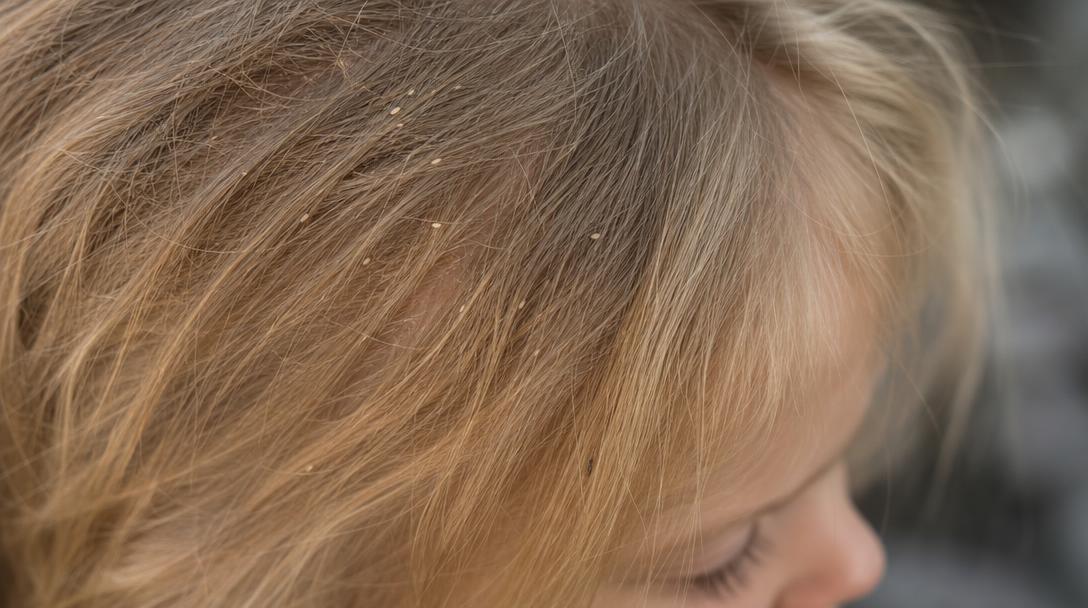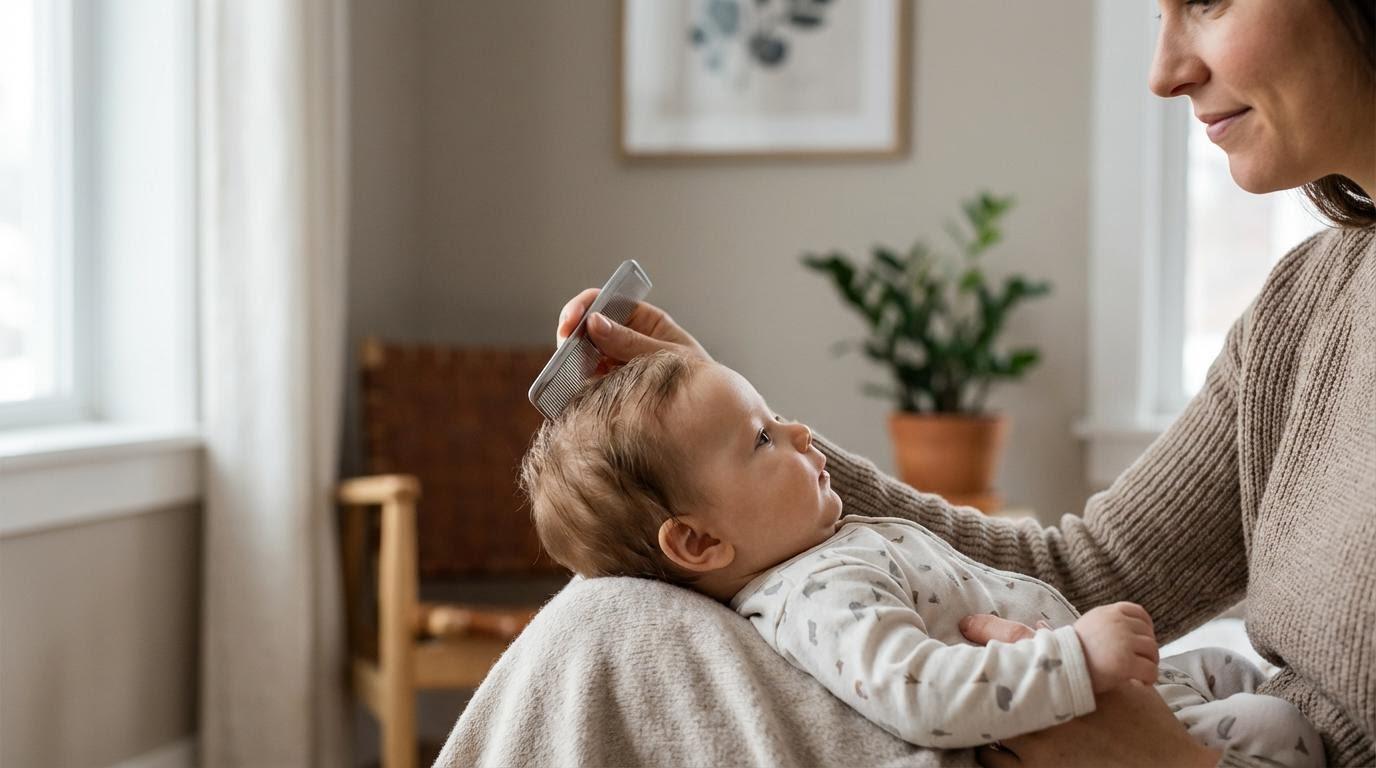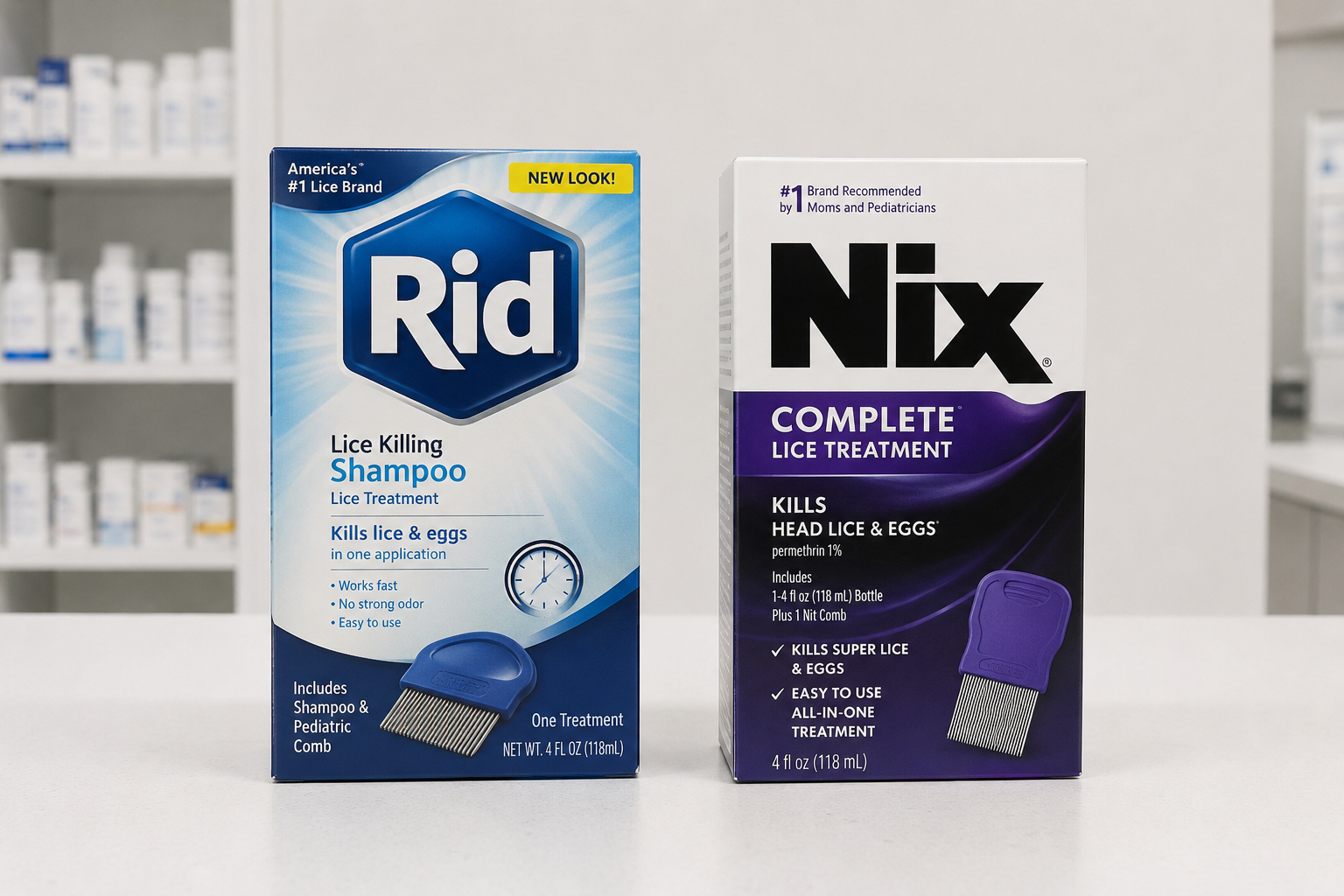

Walk into any CVS, Walgreens, or Duane Reade and you will find Rid and Nix sitting side by side on the same pharmacy shelf. Both cost roughly the same. Both promise to end a lice infestation. And according to nearly every article on the topic, Nix wins – full stop – based on a study showing a 96% cure rate compared to Rid’s 45%.
Here’s the problem with that story: that study was conducted in 1987 – nearly four decades before super lice resistance changed the biology of what we’re actually treating. At Lice Busters NYC, we have cleared over 50,000 families of head lice. We see the real-world aftermath of OTC treatment failures every single week. This guide gives you the honest picture – how each product works, where the science actually stands today, and what matters far more than which brand you grab off the shelf.
What’s in Rid and Nix – The Active Ingredients
The difference between Rid and Nix comes down to a single chemical distinction.
Rid contains pyrethrins – a naturally occurring insecticide extracted from chrysanthemum flowers – combined with piperonyl butoxide. The piperonyl butoxide acts as a synergist, amplifying the pyrethrin’s effectiveness by blocking the enzymes lice use to neutralize the toxin. Together, they attack the nervous system of live lice, causing paralysis and death on contact.
Nix contains permethrin at 1% concentration – a synthetic compound engineered to mimic pyrethrins but with improved chemical stability. Permethrin is designed to leave a residual film on hair strands after rinsing, theoretically staying active for several days to target newly hatched lice even after the treatment is washed out.
The critical shared detail: both chemicals attack the same biological target – sodium channels in the louse’s nervous system. This shared mechanism is what creates the cross-resistance problem that changes everything about this comparison.
How Rid Works
Rid is applied to dry hair and worked thoroughly into the scalp and hair before being left on for exactly 10 minutes. After rinsing, a lice comb removes dead lice and nits from the hair.
What Rid does not do is kill unhatched nits. The egg casing provides a protective barrier that pyrethrin cannot penetrate. This makes a second treatment 7-10 days after the first mandatory – not optional. That repeat application targets any nymphs that hatch from surviving eggs during the interval.
One safety note worth knowing: Rid should not be used by anyone with a documented allergy to ragweed or chrysanthemums. Because pyrethrins come from flower extract, this cross-reactivity risk is worth checking before the first application, particularly in households where children have known pollen allergies.
How Nix Works
Nix is applied to freshly washed, towel-dried hair – a different starting condition from Rid’s dry-hair method. The product stays on for 10 minutes, then gets rinsed out. Like Rid, standard Nix does not kill unhatched nits.
Nix’s distinguishing claim is residual activity. Because permethrin bonds to hair shafts during the application window, newly hatched lice are supposed to contact the residue over the following days and die before maturing. In practice, this residual effect works inconsistently – both because application technique is rarely explained clearly on the label and because resistance has reduced how reliably permethrin kills lice at all.
The standard Nix protocol still calls for a retreat at day 9. Nix Ultra, the newer product-line entry, replaces permethrin entirely with dimethicone – a silicone-based ingredient that physically smothers lice rather than attacking their nervous systems. That makes it a meaningfully different product, not just a stronger version of the original.

Rid vs Nix Effectiveness – What the Clinical Data Actually Shows
The study cited in virtually every comparison article is a 1987 JAMA Pediatrics trial. The results were stark: 26 of 27 subjects treated with Nix became lice-free at the seven-day follow-up, compared to 14 of 31 subjects treated with Rid. That is a 96% vs 45% cure rate – a genuinely significant gap.
Those numbers gave Nix a clear clinical advantage for decades. They also represent lice biology from 1987.
Between the late 1990s and early 2000s, Pediculus humanus capitis – the human head louse – began developing a genetic mutation called knockdown resistance (kdr). This mutation alters the sodium channel structure in the louse’s nervous system, making the channel far less sensitive to both permethrin and pyrethrin. The target both drugs attack becomes effectively shielded.
Today, independent studies estimate that as many as 99.6% of head lice in the United States carry at least one kdr mutation. The CDC acknowledges that “the efficacy of pyrethrins may be reduced because of development of resistance” and that permethrin resistance has also developed – though the full scale of the problem remains incompletely studied.
The 1987 trial was testing two products against lice that were largely still susceptible to both. That world no longer exists.
The Cross-Resistance Problem That Makes Brand Choice Almost Irrelevant
Here is the piece most comparisons skip entirely: because permethrin and pyrethrin are chemically similar and attack the identical target site, lice that are resistant to one are typically resistant to both. Cross-resistance is not a theoretical edge case – it is the mechanism that explains why families switch from Rid to Nix after a treatment failure and get exactly the same result.
We see this pattern constantly at Lice Busters NYC. A parent completes two rounds of Nix, sees no improvement, switches to Rid thinking it might work differently. The lice are still there on day 14. The problem is not technique. The problem is that the kdr mutation neutralizes the chemistry of both products simultaneously.
This is why the question “should I use Rid or Nix” may be the wrong question entirely for families dealing with a persistent infestation. If the first product did not work, the second almost certainly will not either.
What the Label Doesn’t Tell You
Several factors that affect outcomes are absent from the consumer-facing marketing on both products.
- Neither product kills unhatched nits. Both require two treatments to have any shot at breaking the reproductive cycle. Skipping the day-9 retreatment is one of the most common reasons treatment appears to fail.
- Nit combing is not optional. Dead lice and surviving nits remain attached to hair after treatment. Without systematic comb-out after each application, you cannot confirm whether the infestation has actually ended.
- Conditioner blocks permethrin. Using any conditioning treatment before or after Nix prevents permethrin from bonding to the hair shaft, which eliminates the residual benefit Nix is supposed to deliver.
- Saturation matters. Most people apply lice shampoo the way they apply regular shampoo. Effective application requires full scalp contact and thorough coverage at the root line – not just mid-shaft and ends.
Our chemical-free lice removal process addresses every one of these variables because it relies on physical removal, not chemistry – which is why it works regardless of which lice strain is present.
When Rid and Nix Both Fail – What to Do Next
If you have completed two full rounds of either product – applied correctly, with the mandatory retreat – and still see live crawling lice on day 9 or beyond, the CDC recommends switching to a different medication class rather than repeating the same agent.
- Dimethicone-based products (Nix Ultra, LiceMD) – work by physically coating and suffocating lice. Resistance does not apply because no nervous system chemistry is involved.
- Prescription treatments – spinosad (Natroba), ivermectin (Sklice), and malathion (Ovide) use entirely different mechanisms and remain effective in many resistant cases.
- Professional manual removal – the most reliable option after OTC failure. A trained specialist using a fine-tooth comb achieves complete removal regardless of resistance, because nothing about the process depends on chemistry.
Our professional lice removal services use a manual comb-out method on every family. It is chemical-free, takes about an hour, and comes with a 100% guarantee – something no OTC product can offer. Flat-rate pricing means no hourly charges or surprise fees, with same-day appointments available across all five NYC boroughs.
Frequently Asked Questions
Is Nix better than Rid for lice?
In the 1987 JAMA Pediatrics clinical trial, Nix achieved a 96% cure rate versus Rid’s 45% at seven days post-treatment. That study remains the primary basis for recommending Nix over Rid. However, super lice resistance has fundamentally altered the treatment landscape since then, and today both products face significant efficacy challenges that make the original performance gap far less clinically meaningful.
What is the difference between Rid and Nix?
Rid contains pyrethrin (derived from chrysanthemum flowers) plus piperonyl butoxide, and is applied to dry hair. Nix contains permethrin, a synthetic compound, and is applied to damp hair after shampooing. Both target the same nervous system pathway in lice, which is why resistance to one typically means resistance to the other.
Does Rid or Nix kill lice eggs (nits)?
Neither product reliably kills unhatched nits. Both Rid and Nix target live lice through nervous system disruption, but the egg casing protects nits from chemical exposure. This is why both manufacturers require a mandatory second treatment 7-10 days after the first – to target any lice that hatch from surviving eggs before they reach reproductive maturity.
How many treatments do Rid and Nix require?
The standard protocol for both products is two treatments: the initial application, then a retreat on day 7-9. The CDC clinical care guidelines recommend switching to a different treatment class entirely if live lice persist after two complete rounds of the same product.
Can lice become resistant to Rid and Nix?
Yes. A genetic mutation called knockdown resistance (kdr) alters the sodium channels that both pyrethrin (Rid) and permethrin (Nix) target. Lice carrying this mutation are resistant to both chemicals simultaneously. Studies estimate that super lice now account for the vast majority of head lice infestations across the United States, which significantly limits how reliably either OTC product performs today.
What is the difference between Nix and Nix Ultra?
Standard Nix contains permethrin (1%), a synthetic pesticide that kills lice by attacking their nervous systems. Nix Ultra replaces permethrin entirely with dimethicone, a silicone compound that kills lice by physically coating their respiratory passages. Because dimethicone’s mechanism is physical rather than chemical, lice cannot develop genetic resistance to it – making it the better OTC choice when previous permethrin or pyrethrin treatments have already failed.
The Bottom Line
Between Rid and Nix, Nix has the stronger clinical track record – but that record is nearly 40 years old and was built before super lice resistance became the dominant reality in American households. Today, both products face the same resistance ceiling, and the brand on the bottle matters far less than whether the lice in your child’s hair carry the kdr mutation. If OTC treatments have not worked, or if you would rather skip the trial-and-error entirely, Lice Busters NYC offers same-day, chemical-free removal backed by a 100% guarantee. We have treated over 50,000 NYC families – because sometimes the most effective lice treatment is not on any pharmacy shelf.